

Cinder, step by step.
Practical guides for reviewing, protecting, backing up, rebuilding, and removing contacts.
A note about the screens: Names, photos, and counts are examples. System diagrams are illustrations; follow Apple’s or Google’s current instructions for system-owned steps.
How Cinder works
Cinder separates finding, deciding, confirming, backing up, and deleting so one quick gesture cannot erase a contact.
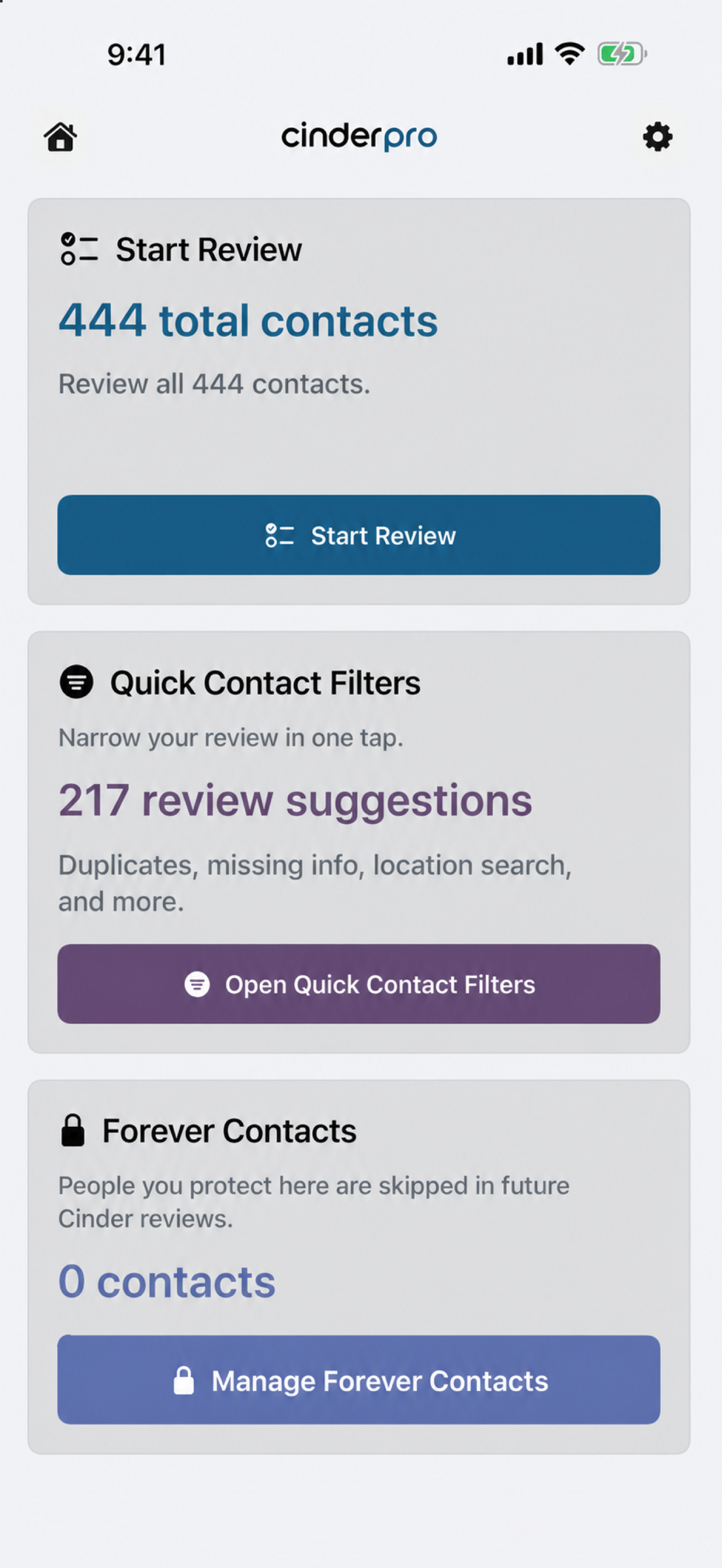
- Choose a starting point. Start Review opens contacts Cinder can access that are not protected as Forever Contacts. Quick Contact Filters opens a focused job. Forever Contacts opens the people Cinder should skip.
- Review each contact. Keep, Mark for Removal, and Make Forever Contact are review decisions. Request Info opens an editable request without deciding the contact. Gestures and visible controls are available, with Undo beside them.
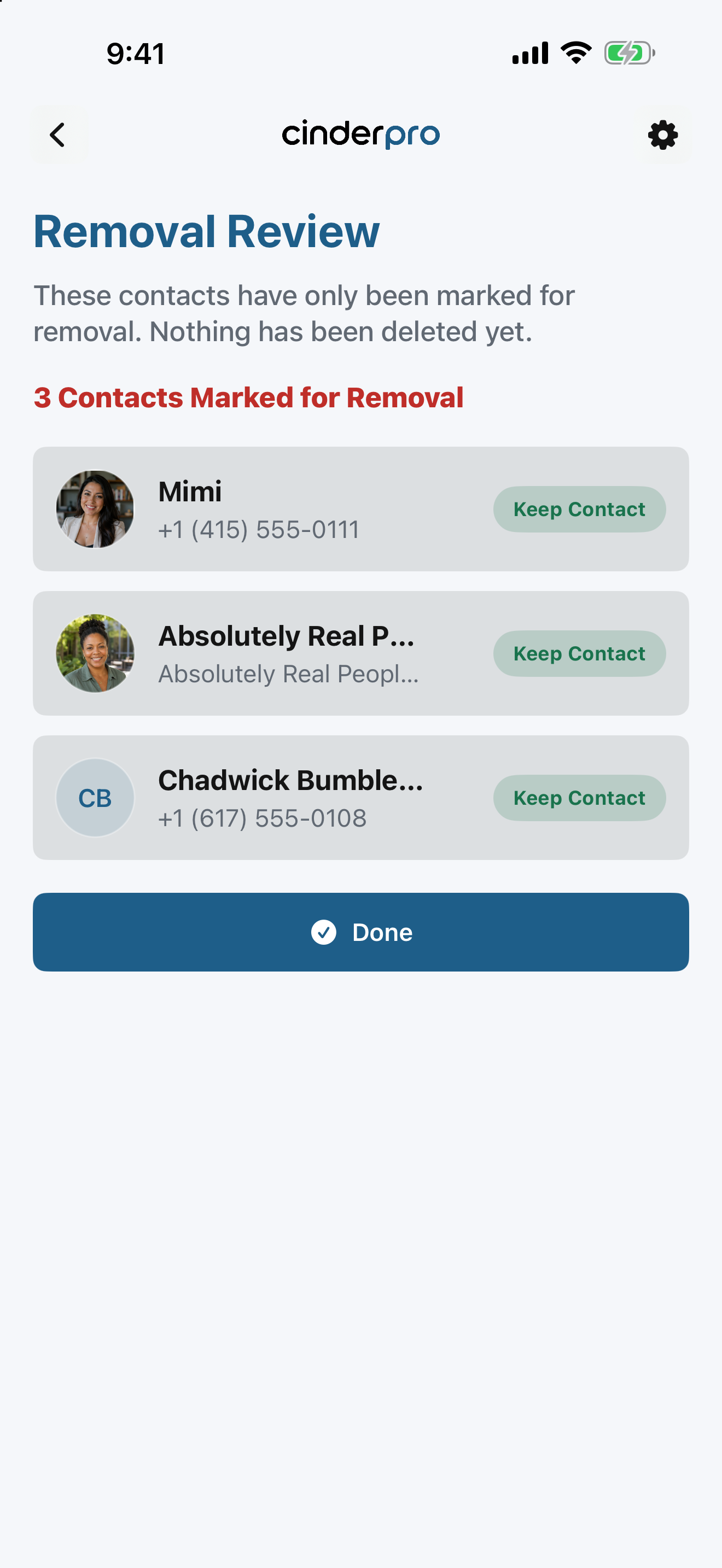
- Finish later or finish now. Finish Later saves progress. Finish Now opens the Removal List when contacts are marked. Use Keep Contact to pull one back.
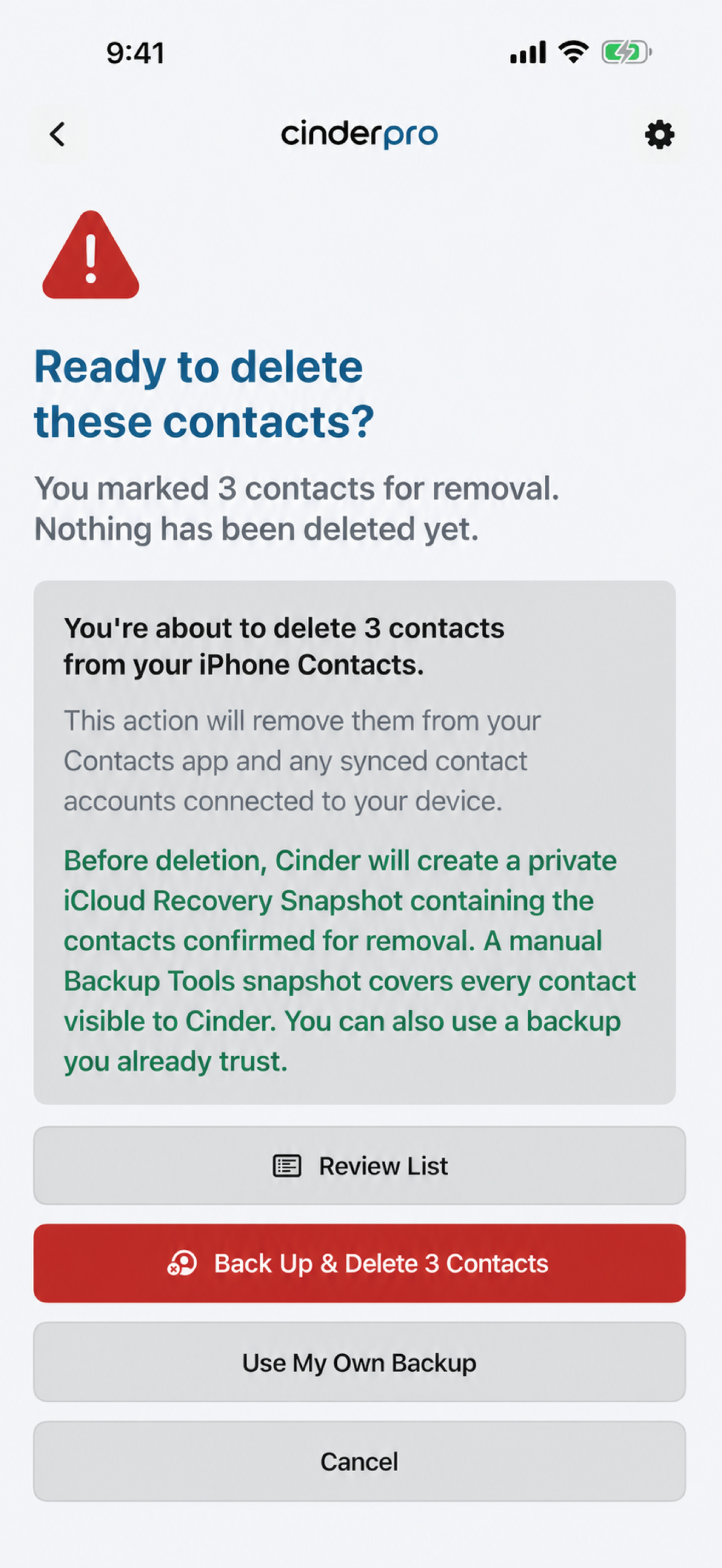
- Prepare for deletion. After the Removal List, accept the agreement when required and review the final screen. The default path protects exactly the confirmed removal set with a Contacts Only Recovery Snapshot; you may explicitly rely on another current backup you have verified instead.
- Start the final flow once. Tap the red Backup & Delete button only when ready; its label shows the exact contact count. After the default snapshot verifies, deletion proceeds without another confirmation. Synchronized account behavior still applies.
Review up to 15 unique contacts free. Cinder Pro unlocks unlimited reviews, Quick Contact Filters, backups and recovery, import and export, and contact removal. Cinder Pro is $4.99 in the U.S. for a one-time lifetime purchase. No subscription. Apple shows your local price before you confirm. Open a locked feature or finish your free review, choose Unlock Cinder Pro, then Agree & Continue to Apple. Review the price and confirm your purchase with Apple. If you already own Cinder Pro, use Restore Purchase while signed in to the Apple Account used for your purchase. Contact support if Pro remains locked.
Your first contact review
The main review is a decision queue. You handle one contact at a time, and Cinder remembers where you stopped.
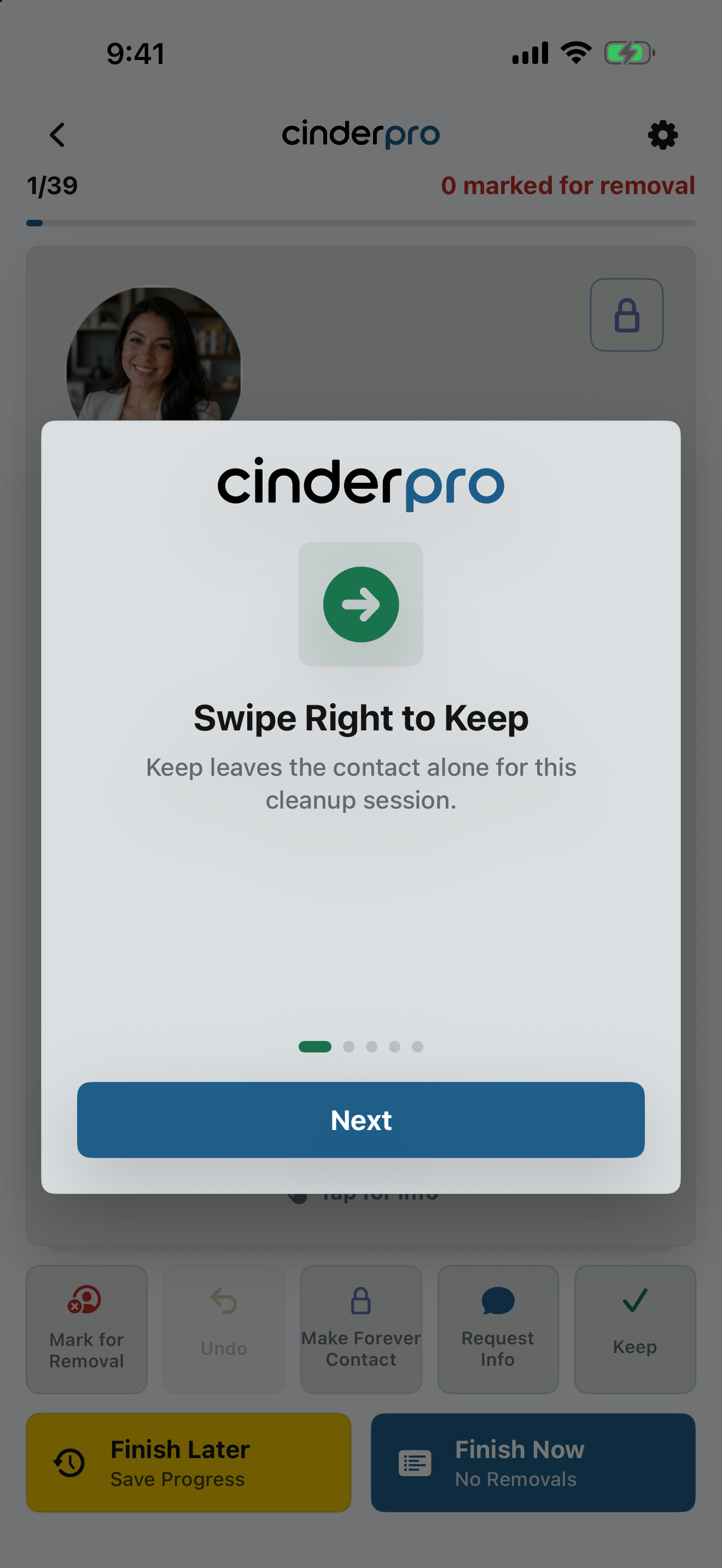
- Allow Contacts access. Full access lets Cinder review accessible contacts that are not protected as Forever Contacts. With limited access, Cinder sees only the contacts iOS permits, still excluding Forever Contacts from review.
- Open the review. If no review is saved, tap Start Review. To reopen saved progress, choose Resume Previous Review. Starting another review while progress exists asks you to resume it or Start Over and Lose Progress. Nothing is deleted by opening or viewing a card.
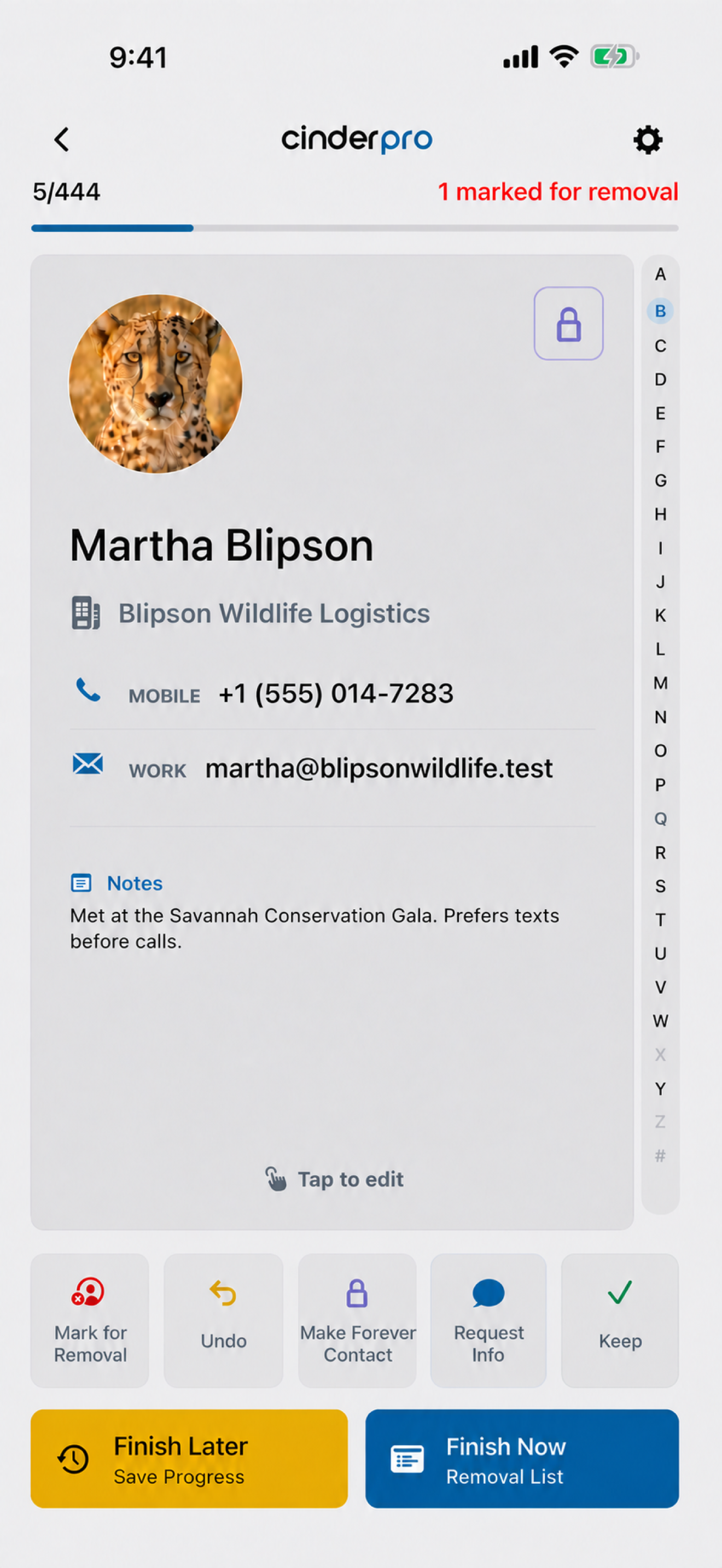
- Inspect the full card. Tap the card when you need more detail. Names, photos, area codes, companies, and timestamps can be misleading on their own.
- Choose a decision or request. Keep, Make Forever Contact, or Mark for Removal decides the contact. Request Info opens an editable request without deciding it. Swipes and visible buttons perform the matching actions.
- Stop whenever you need to. Finish Later saves progress. Finish Now continues to the Removal List when you have marked contacts.
What each decision does
- Keep: finishes the contact for this review.
- Make Forever Contact: keeps the contact, saves protection locally first, and privately syncs that protection through your iCloud account when available.
- Request Info: prepares a message you review before sending.
- Mark for Removal: adds the contact to a separate Removal List; it does not immediately delete it.
Swipes and their button fallbacks
- Swipe right → Keep. The Keep button performs the same decision.
- Swipe left → Mark for Removal. The Mark for Removal button performs the same decision.
- Swipe up → Make Forever Contact. The lock button performs the same decision.
- Swipe down → Request Info. The Request Info button opens Request Updated Info. The card returns to rest and no review decision is recorded merely by opening the request.
- Tap the outlined lock on the card → Make Forever Contact. This is an additional visible path to the same protected Keep decision.
Undo reverses the latest supported review action. When that action also added the person to Forever Contacts, Undo reverses both the Keep decision and the newly added Forever protection.
No gesture is required. The five-button control row covers Mark for Removal, Undo, Make Forever Contact, Request Info, and Keep. The outlined lock on the card is another way to make someone a Forever Contact.
Finish Later saves the review. It saves the overall checkpoint; it does not classify the active contact. There is no per-contact Later button or Later swipe.
Request missing details without losing your place
Request Info prepares an editable message for a contact. You choose the details, review every word, and decide where to send it.
You stay in control. Cinder cannot read the reply or update Contacts for you.
- Open Request Info. Swipe the active card down or tap Request Info. The card springs back, Request Updated Info opens, and no review decision is recorded.
- Check the tone. Cinder starts Friendly for personal context or Professional for company/work context. Switch either way and edit the opening if needed.
- Choose what to request. Current name, mobile, landline, work number, home address, personal email, work address, work email, birthday, or an updated contact card. Clear every option for a general update request.
- Review the complete draft. Checked fields control the request sentence. You can still edit every word and optionally add the default-off Cinder recommendation.
- Send or copy it. If any phone value contains a digit, Cinder selects Messages, then uses the first mobile/cell/iPhone-labeled number or otherwise the first number. Only when no phone value contains a digit does Cinder select the first nonempty email for Mail. Copy Request Text preserves the exact edited draft for another app.
- Handle the reply yourself. Read the response and deliberately update the contact in Apple's Contacts app.
Request Info does not use one of the 15 free reviews by itself. Opening, editing, copying, or sending a request is separate from making a final review disposition.
Cinder does not monitor the conversation. It cannot read Messages or Mail replies, extract the returned details, or update the contact automatically.
Read the Request Info FAQ for transport, tone, field, copy, and privacy details.
Use Quick Contact Filters without over-trusting them
Quick Contact Filters shrink a large address book into a specific cleanup job. Every result is still yours to judge.
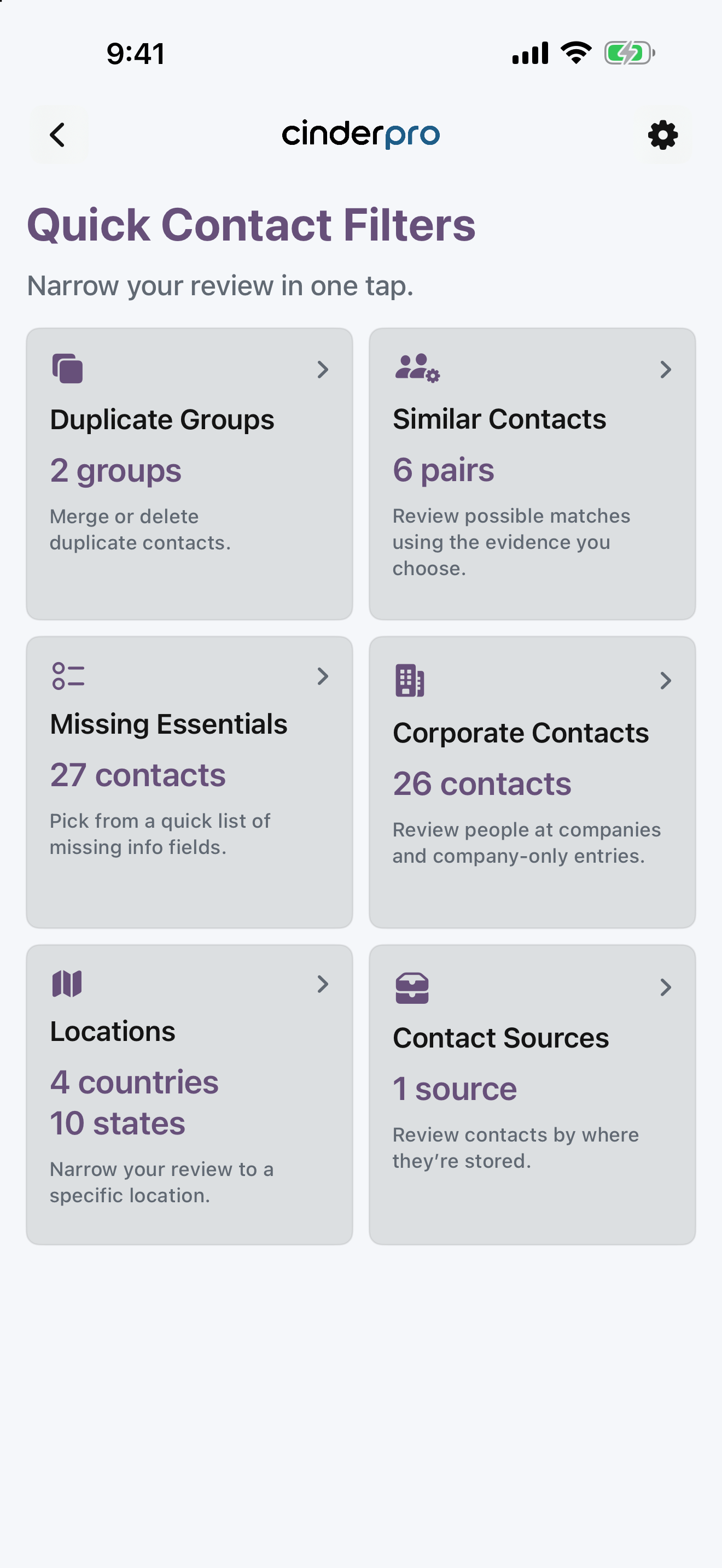
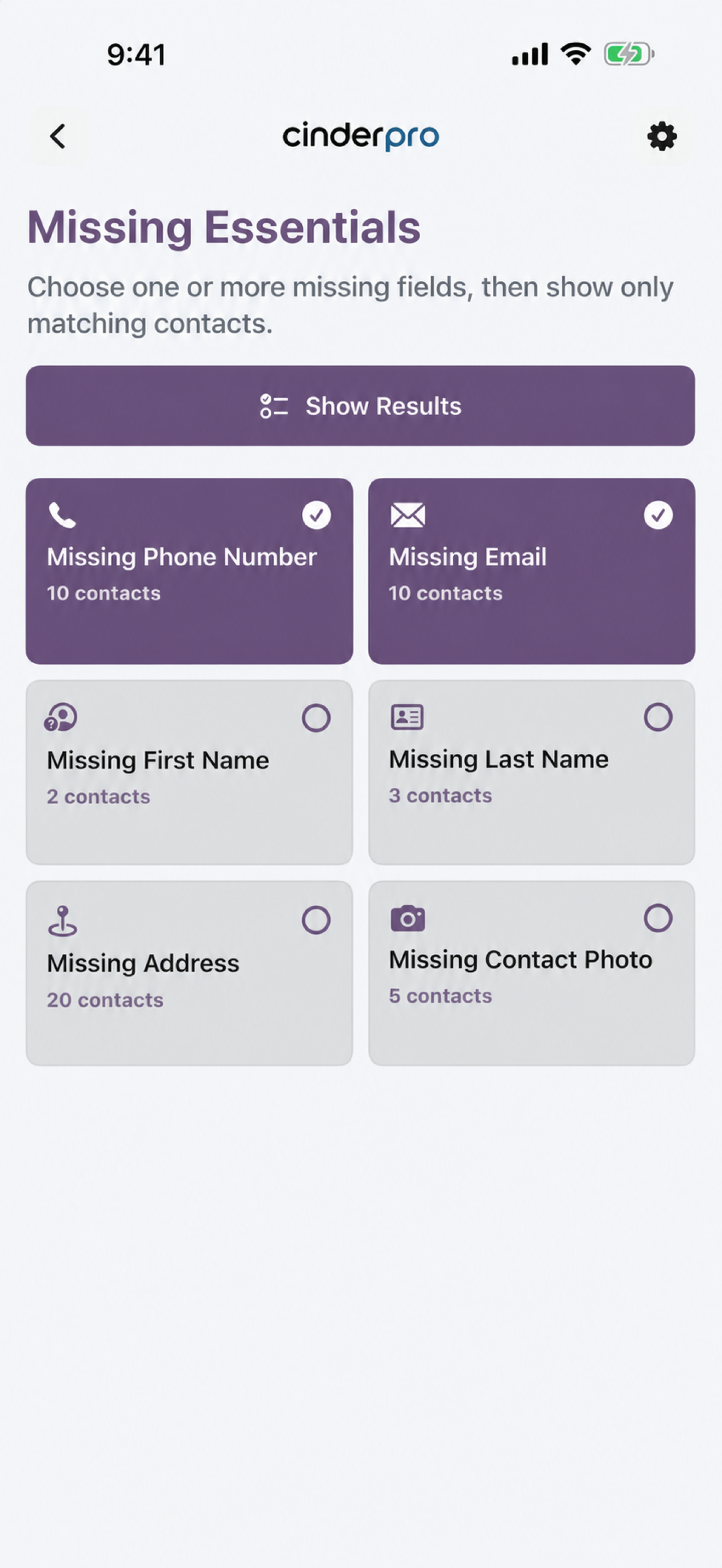
- Open Quick Contact Filters from the dashboard.
- Choose the kind of mess. Duplicate Groups, Similar Contacts, Missing Essentials, Corporate Contacts, Locations, or Contact Sources.
- Review the result count. A count is a suggestion set, not a deletion recommendation.
- Open the result. Missing Essentials, Corporate Contacts, Locations, and Contact Sources start focused contact review. Duplicate Groups and Similar Contacts open comparison tools instead.
- Remember the single saved review. A focused filter starts its own review set. If another review is unfinished, choose Resume Previous Review or Start Over and Lose Progress.
Read the filters as clues
A contact with a “missing” field may have the information somewhere Cinder cannot read. An area code does not prove where someone lives. A company-only card may be necessary for a front desk or support line. A duplicate group may contain two different people.
What each current filter does
- Missing Essentials: lets you combine missing phone, email, first name, last name, address, and contact-photo checks.
- Duplicate Groups: opens deterministic possible-duplicate evidence and merge review; it is not an automatic merge.
- Similar Contacts: shows looser possible matches for review; similarity is not proof that two cards belong to the same person.
- Locations: drills into countries, U.S. states, or available phone/address clues before showing results.
- Corporate Contacts: separates people with company information from company-only cards, then starts a review only after you choose the result set.
- Contact Sources: narrows review by the source Cinder can identify for the contact.
Good rule: use a filter to decide what to inspect, never what to delete automatically.
Understand the Forever Recovery Vault
Forever Contacts stay out of future Cinder reviews. The separate Forever Recovery Vault can keep one durable Forever Recovery Snapshot for each protected person.
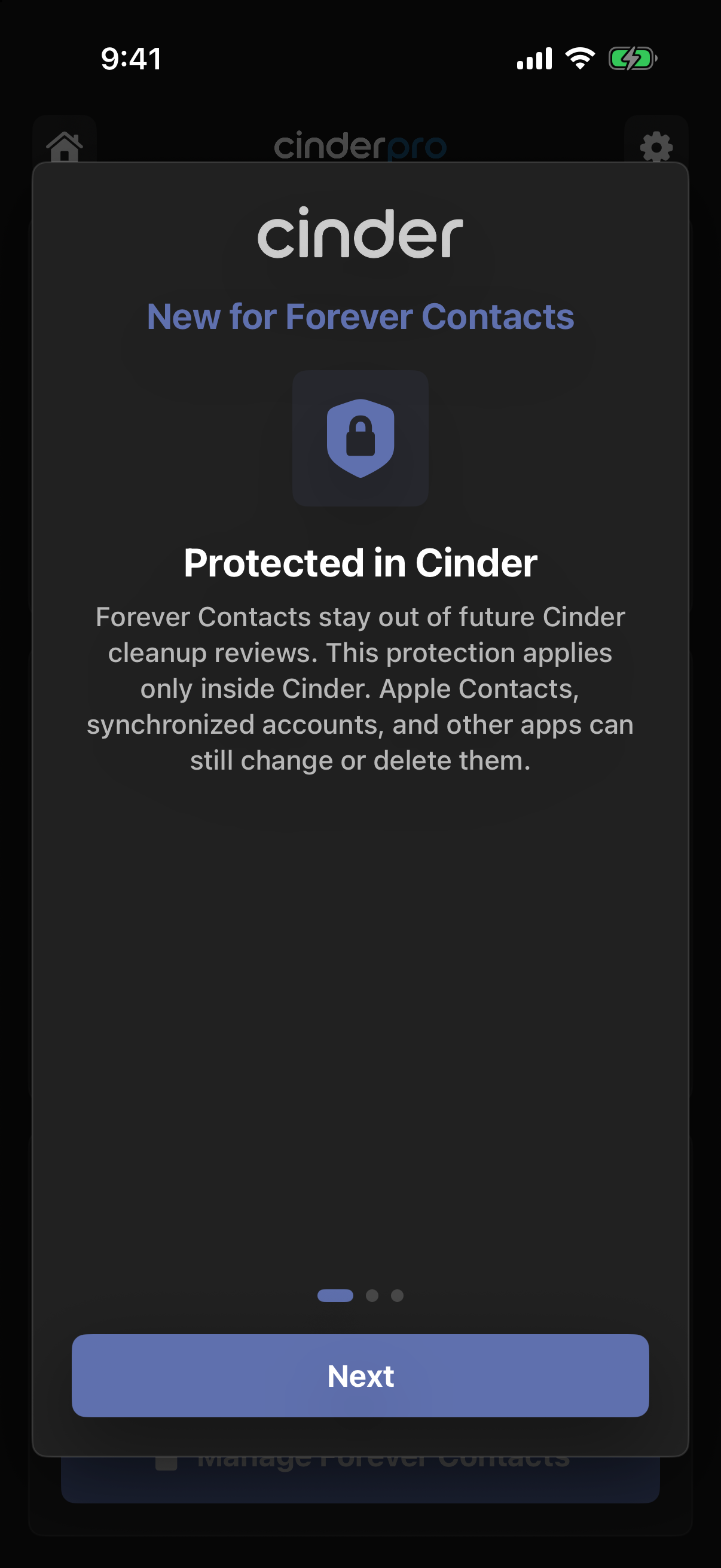
Open the Vault from Forever Contacts
In the Forever Contacts manager, the centered, title-only Forever Recovery Vault entry appears directly above Add to Forever Contacts. It is the starting point for coverage, verification, status details, retries, and recovery review.
The manager orders matched contacts A-Z by family name, then given name, company, and full name. If Limited Contacts access leaves a saved membership unmatched, Cinder keeps its saved display name instead of guessing which word is a surname. The Add chooser intentionally keeps the order supplied by Apple Contacts, even after filtering, so selecting people does not unexpectedly reorder the source list.
Protection and consent are separate
- Add a Forever Contact. Swipe up, tap Make Forever Contact, tap the outlined lock, or use Add to Forever Contacts. Membership saves locally first, works offline, and keeps the person out of future Cinder reviews.
- Read the disclosure. New for Forever Contacts and Learn How Forever Recovery Works explain the system; reading either one does not authorize a snapshot.
- Approve the exact people. A new snapshot begins only for contacts just added through an authorized action or contacts you explicitly select with Create Forever Recovery Snapshots. Not Now preserves Forever protection and defers creation for that app run.
Existing Forever Contacts without a remotely verified Forever Recovery Snapshot, including a failed or pending attempt, are offered Create Forever Recovery Snapshots or Not Now when Cinder activates. Not Now defers only that run. A previously approved pending attempt may retry, and later launches keep offering creation until remote verification succeeds.
Contacts Only first, then one contact-photo choice
- Prepare one complete card. After approval, Cinder exports Contacts Only for that Forever Contact. Accessible Contact Notes are included automatically; Cinder stops if it cannot preserve and verify a Note exactly.
- Verify the private snapshot. Cinder hashes and counts the exact VCF bytes, uploads them, fetches them again from private iCloud, and verifies the hash, byte count, and one-card VCF before calling the snapshot current.
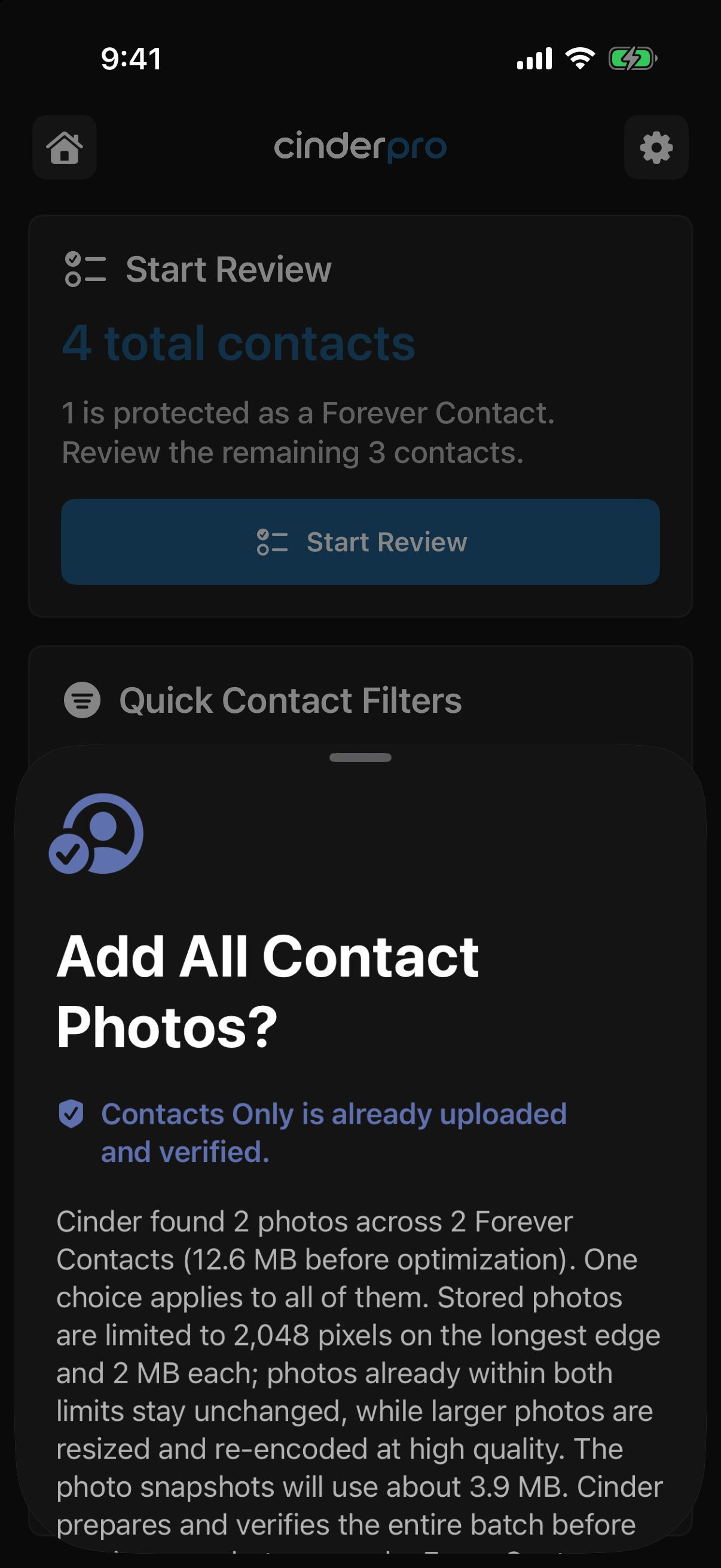
- Make one all-or-none choice. Only after every eligible Contacts Only snapshot in the approved run verifies does Cinder ask Add All Contact Photos? One choice covers every eligible Forever Contact in that run; Cinder never asks person by person.
- Keep the batch atomic. If you choose Include All Contact Photos, Cinder prepares and round-trip verifies the entire batch before staging any photo upgrade. If one photo cannot be prepared or verified, none of the batch is staged.
- Apply the shared photo limits. A contact photo already at or below both 2,048 pixels on its longest edge and 2,000,000 encoded bytes stays byte-identical. Larger photos are orientation-corrected, resized, and high-quality JPEG re-encoded until both limits are met. Invalid photo data fails closed.
- Keep the verified version. Every verified Contacts Only snapshot remains current until its own photo-bearing replacement passes remote readback. Choosing Keep Contacts Only syncs across devices for that exact recoverable-data version and is not offered again until the recoverable data changes.
Know when a photo upgrade is complete
The photo-upgrade sheet stays on screen through the choice, work, and result. Keep Cinder open while it prepares, uploads, and performs final verification; locking the device or leaving the app may pause that work.
- Contact Photos Verified: every expected contact in the batch has the current photo-bearing snapshot fetched back and verified in private iCloud. Counts and expected photo hashes all match, with no pending or unresolved contact.
- Photo Verification Pending: only the displayed verified count has completed. The remaining contacts are either locally staged and waiting for upload or final verification, or need review in the Vault. Pending does not mean cloud-verified; the previously verified Contacts Only snapshots remain current.
- Contacts Only Kept: you declined the photo upgrade. No photo work was requested, and the verified Contacts Only snapshots remain current.
Notify Me When Verified is off by default. Turning it on requests notification permission. Cinder may send one count-only completion notification only after the entire durable batch receipt is fully verified; it does not include contact names, fields, hashes, or file paths. Delivery still depends on notification permission and scheduling, observes Cinder's 9:00 p.m.-9:00 a.m. quiet hours, and opens the Vault when tapped. Deleting the relevant Vault work cancels a delayed completion notification.
Updates happen only with approval
With authoritative full Contacts access, Cinder may perform read-only change detection while you are using the app. A meaningful change produces Update Forever Recovery Snapshot or Not Now. Detection alone stages and uploads nothing. Approval re-exports the exact offered data version; Not Now suppresses the offer for that run. The prior verified snapshot remains current until the replacement is uploaded, fetched again, and verified.
No scheduled or background backups. Cinder does not run autonomously in the background or create automatic, recurring, or monthly backups. Reopen Cinder and request or approve a new Recovery Snapshot or Forever Recovery Snapshot whenever you want a fresher one. Creation, update, contact-photo inclusion, rebuild, removal, and deletion always require an in-app choice.
Read coverage and latest verification
Verified snapshots shows how many Forever memberships have at least one private-iCloud snapshot that was fetched back and verified. Latest verified is the time of the most recent successful verification. Open either row to see the exact matching contacts and their verification dates. These two rows are informational and do not change Contacts or Vault data.
Coverage and current status are separate. A contact can have an older verified snapshot and also appear in Upload Pending, Needs Attention, or another current-status row. Only the verified count represents remotely verified coverage.
Read each current status and its action
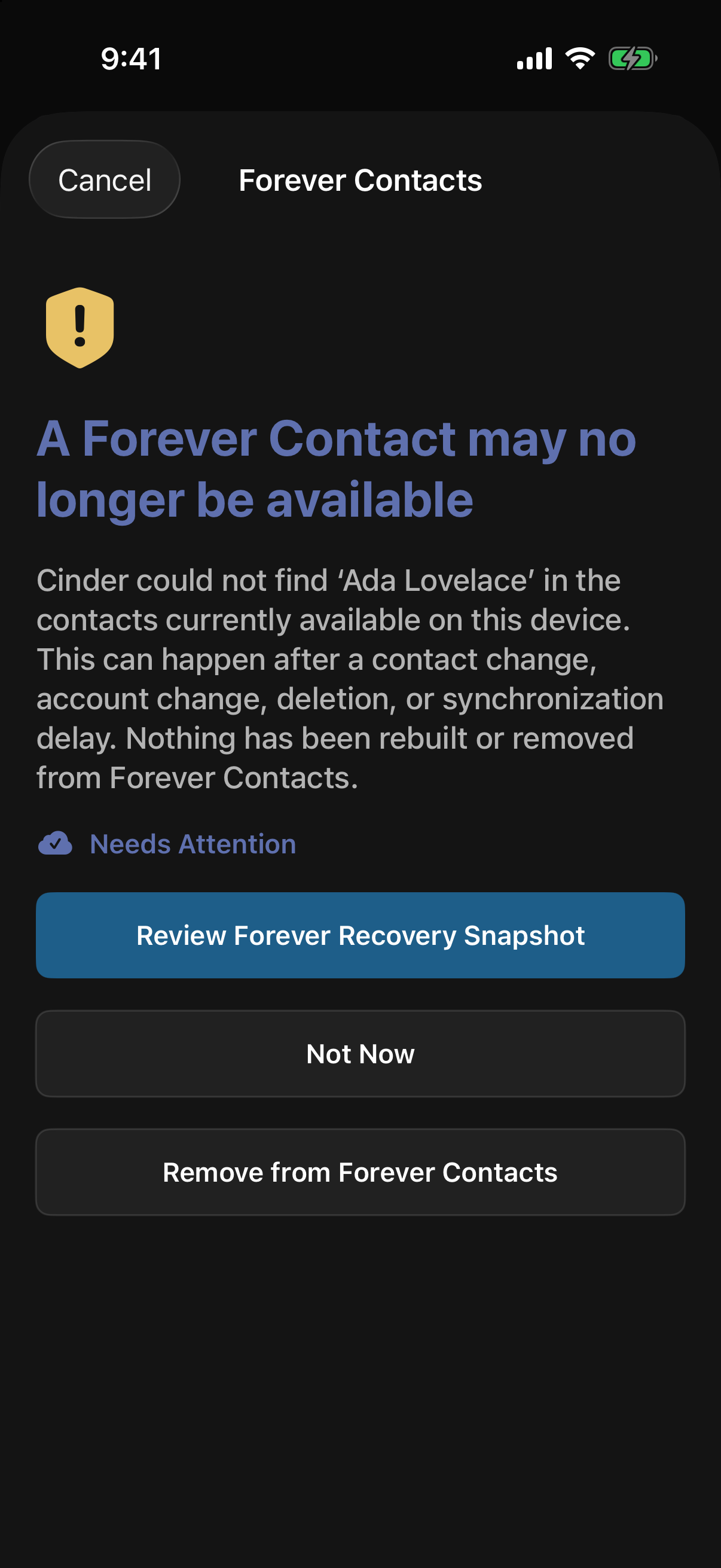
- Needs Attention: Cinder previously saw the contact, then could not find its exact identifier or one unambiguous phone or email match during two successful Full Contacts checks at least 24 hours apart. Open the row to see the affected contacts; Review Now opens the saved snapshot and recovery choices. Nothing is rebuilt, removed, or deleted automatically.
- Review Later: the same missing-contact review was postponed for seven days. Membership and the snapshot are unchanged; open the row and choose Review Now whenever you are ready.
- Upload Pending: a new or updated snapshot is stored locally and still awaits private-iCloud upload or final verification. A previous verified snapshot remains available when one exists. Open the row to see exactly which contacts are pending, then use Try Again for only those contacts.
- iCloud Unavailable: the last attempt could not reach or verify private iCloud. Local pending work and any previous verified snapshot are preserved. Try Again targets only the contacts listed in that row.
- iCloud Storage Full: private iCloud reported insufficient storage. Free storage or upgrade the plan, then use the row's targeted Try Again.
- No Recovery Snapshot: Forever membership still excludes the person from Cinder review, but there is neither local pending work nor a verified snapshot. With Full Contacts access, a visible contact list, and Cinder open, Create Recovery Snapshots prepares only the listed contacts; private iCloud must still upload and verify them.
- Deletion Pending: a Vault deletion request is stored locally, but private-iCloud deletion has not been verified. The live Apple contact is unchanged. Retry Deletion targets only the contacts in this row.
Every populated current-status row opens a contact list scoped to that status. Each contact shows its current status and either the last verified date or No verified snapshot yet. Informational coverage and latest-verification views remain read-only; retry, create, delete, and review controls appear only where that action matches the displayed status.
If a Forever Contact cannot be found
Cinder first checks the exact Contacts identifier, then only a unique phone or email match. Needs Attention requires two successful, nonempty, stable-source imports with full Contacts access at least 24 hours apart. Limited, denied, restricted, or undetermined access; failed, empty, incomplete, or ambiguous data; unknown scope; and account or source transitions do not count as a miss.
The quiet attention flow offers Review Forever Recovery Snapshot, Not Now, or Remove from Forever Contacts. Review shows the saved fields before any rebuild. A rebuild creates and verifies a new Apple Contacts card, normally in the default account with a new identifier, then rebinds the same stable Forever membership. It never overwrites an existing contact or runs automatically. Groups, original accounts, linked-contact structure, original identifiers, and provider-specific metadata are not promised; Contact Notes fail closed.
Retention and deletion stay isolated
The Vault keeps one current verified Forever Recovery Snapshot per stable Forever membership UUID, plus protected pending work only while needed. Removing a Forever Contact deletes or safely queues deletion of that contact's snapshot; the live Apple contact is not deleted. Delete All Forever Recovery Snapshots preserves Forever memberships and deletes only Vault snapshots. Deleting the app does not promise deletion of private CloudKit data.
Separate systems. Forever Recovery Snapshots are outside the 25 ordinary Recovery Snapshot families, consume none of those slots, and cannot be deleted by ordinary snapshot controls. Vault deletion cannot touch ordinary Recovery Snapshots. Forever protection applies only inside Cinder; Apple Contacts, synchronized accounts, and other apps can still change or delete the live contact.
Handle possible duplicates carefully
Duplicate tools can create a useful combined card, but matching is never a guarantee of identity.
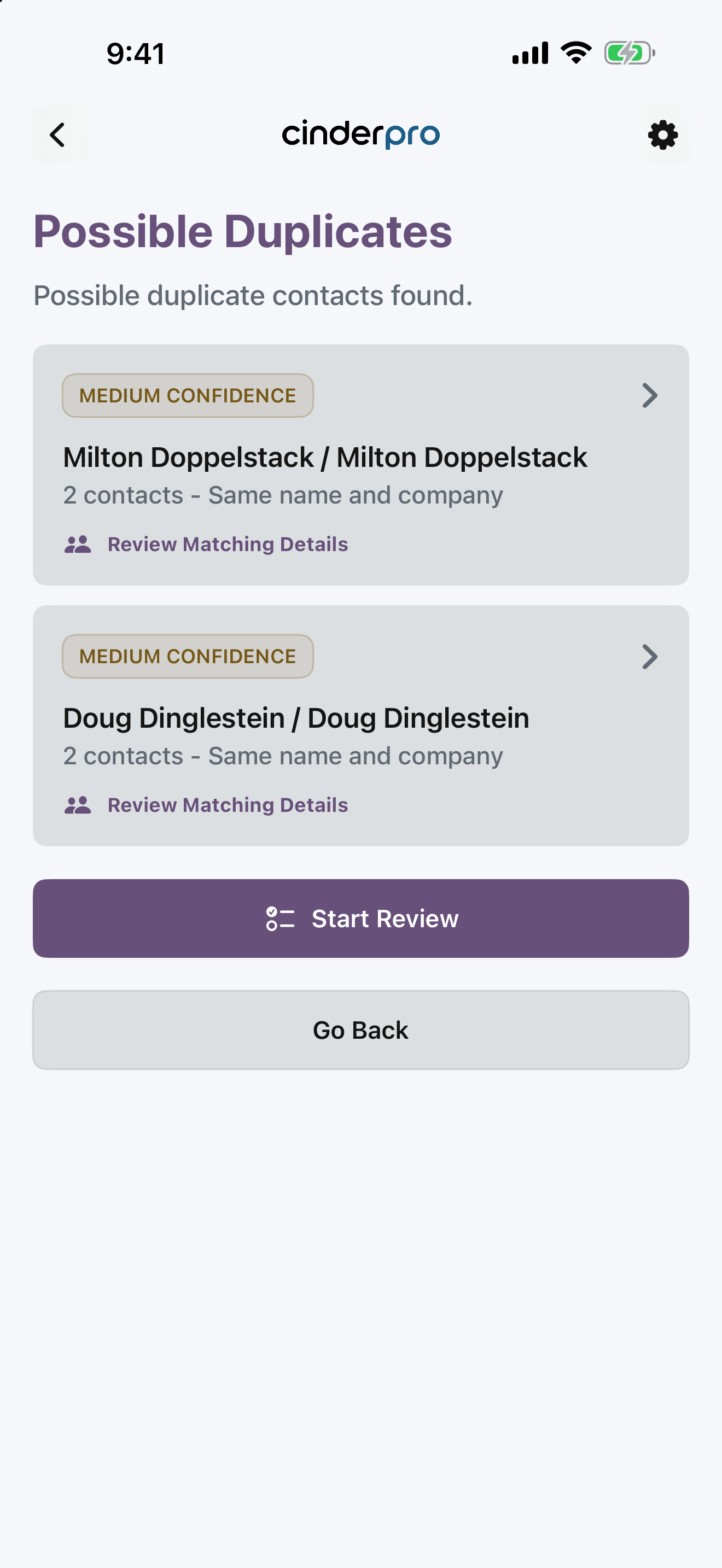
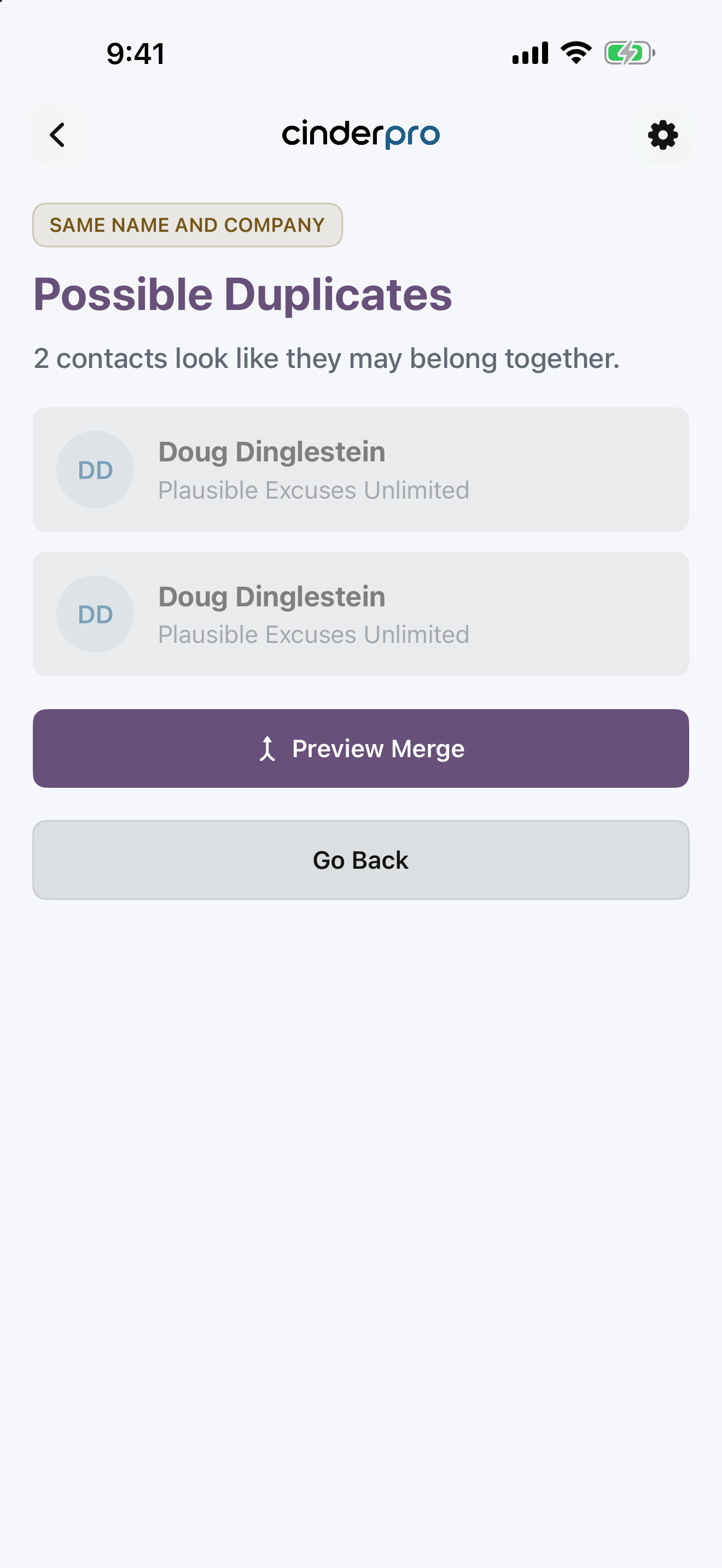
- Open Duplicate Groups in Quick Contact Filters.
- Open Review Matching Details. Compare names, phone numbers, email addresses, organizations, labels, photos, and account sources.
- Tap Preview Merge. Read the proposed combined contact. If two fields disagree, choose what belongs on the new card.
- Inspect every card. Open Apple Contacts and check the new merged card before completing the separate removal steps for the originals.
Merging may not preserve every label, linked-contact relationship, source account, image, note, group, or provider-specific field. Keep an independent backup of important records.
Review Similar Contacts as possibilities
Similar Contacts finds looser possibilities that still require your judgment. Choose one or more kinds of evidence, then review each suggested pair.
- Choose the evidence. Select similar names, organizations, phone variations, email variations, or postal addresses, then tap Show Suggestions.
- Compare the pair. Read the evidence and inspect both contacts before acting.
- Choose an action. Not a Match hides the pair until either contact materially changes. Review Later skips it for this review. Review & Merge opens an editable merge preview without changing Contacts yet.
This Review Later is separate. It skips only the current Similar Contacts pair for the current review. It is not saved as a main-review contact decision and is unrelated to Finish Later.
Understand private iCloud Recovery Snapshots
An ordinary Recovery Snapshot is a verified .vcf Cinder stores in your private iCloud database after your in-app request. It preserves supported contact details, not every part of an address book.
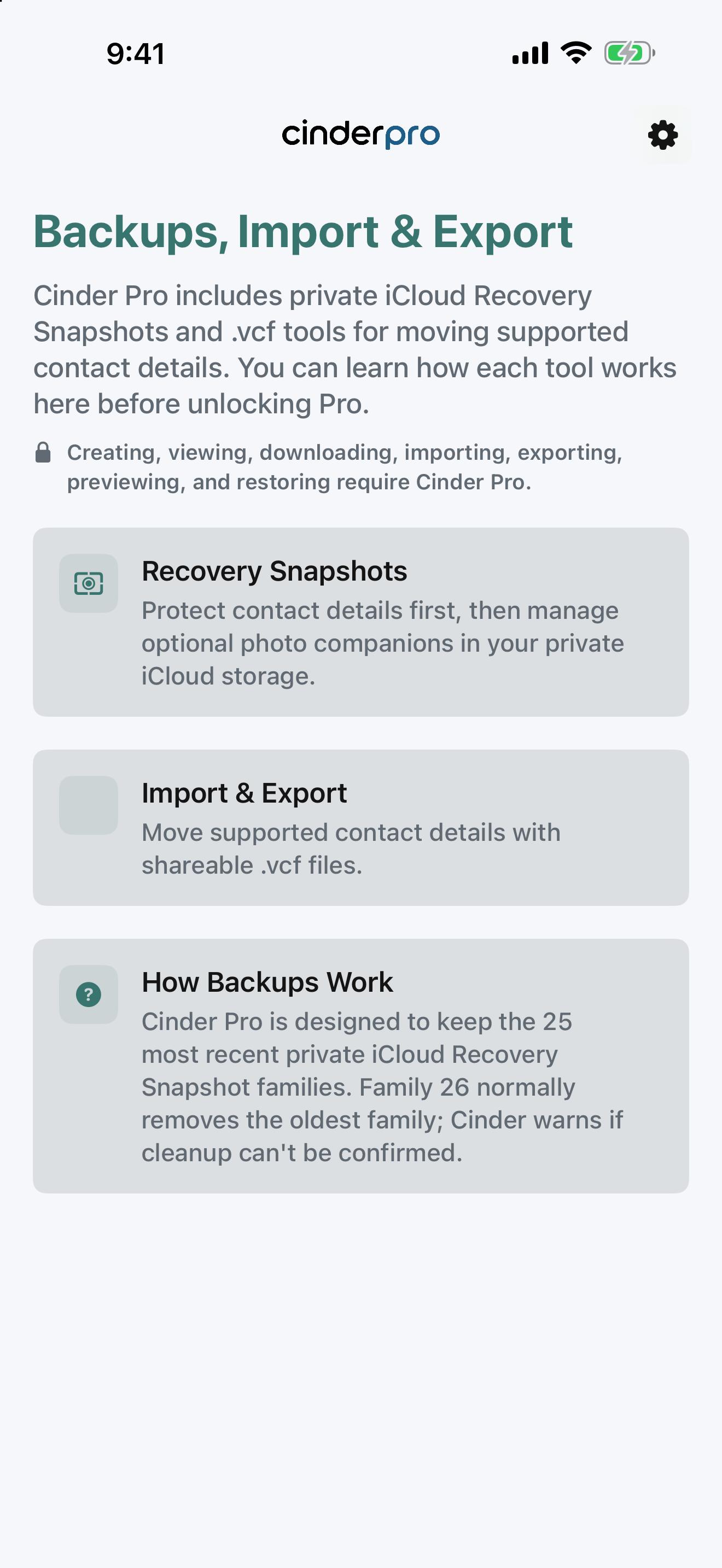
User-started, never scheduled. Create an ordinary Recovery Snapshot from Settings, or tap Backup & Delete to request the pre-deletion snapshot and confirmed deletion flow. Cinder does not create monthly or background backups; reopen the app whenever you want a fresh snapshot.
What happens when Cinder saves one
- Cinder chooses the scope. A pre-deletion snapshot contains exactly the contacts you finally confirmed for removal. A manual snapshot contains every contact currently visible to Cinder. Limited Contacts access limits either scope.
- Cinder protects Contacts Only first. It creates, uploads, fetches again, and exactly verifies the complete .vcf before calling the snapshot safe. Every Contact Note available to Cinder is included automatically; Cinder stops if it cannot read, write, and verify one exactly.
- Contact photos stay optional. A matched Contacts + Photos companion can follow. The shared photo encoder keeps already-valid images byte-identical and safely optimizes larger images to no more than 2,048 pixels on the longest edge and 2,000,000 encoded bytes. Cleanup does not wait for that companion once Contacts Only is safe.
- The family stays private. The snapshot uses the Apple Account’s private iCloud storage, not a developer-owned contact database.
- Cinder manages up to 25 ordinary families. Contacts Only and its optional matched photo companion use one family slot together. Family 26 normally removes the oldest ordinary family; Cinder warns if cleanup cannot be confirmed. Forever Recovery Snapshots are separate and use no ordinary family slot.
If private iCloud is not available
Cinder may report that no Apple Account is signed in, iCloud is restricted, storage is full, the service is temporarily unavailable, or the app cannot determine the status. The private iCloud button stays unavailable until the problem is fixed.
In the final cleanup flow, failure stays safe: nothing is deleted. Choose Retry Recovery Snapshot, Delete Using My Backup, Cancel Cleanup, or Contact Support. Save My Own .vcf also appears when Cinder has a prepared file it can hand to the share sheet.
Your account is part of the backup. Before changing Apple Accounts, leaving a job, or moving to Android, download an independent .vcf and check that it opens. If a work account owns the contacts, get permission before taking a copy.
Share a verified .vcf
Cinder creates and verifies a shareable contact file, then presents it to the system share sheet. The system controls the available destinations and their order.
- Open Settings → Backups, Import & Export. Choose Import & Export, then Export .vcf File. To copy an existing Recovery Snapshot, open its menu and choose Download .vcf.
- Choose whether to include contact photos. Contact Notes available to Cinder are included automatically. Photos are optional; larger photos are safely optimized to the shared 2,048-pixel and 2,000,000-byte limits.
- Wait for verification. Cinder checks the complete file before presenting the system share sheet.
- Choose a durable destination. Save to Files may be available, but the system decides which actions and apps appear. A third-party destination follows that provider’s rules.
- Complete the handoff. Canceling the share sheet does not make an independent copy.
- Verify the copy. Find it at the destination, check its date and size, and make sure it can be opened. You can use Import .vcf for Restore to inspect Cinder’s preview without selecting anything.
- Copy it off the account when needed. Send it to a computer, another storage provider, or an encrypted drive you control. A .vcf can contain private information about many people.
A handoff is not proof of storage. Opening the share sheet, copying, printing, or AirDropping does not by itself prove a durable backup exists. Find and open the saved file before relying on it.
Backup contact photos
Cinder protects Contacts Only first and offers contact photos separately. Each stored photo must be within both 2,048 pixels on its longest edge and 2,000,000 encoded bytes.
Large photo snapshot verified
The complete Contacts + Photos VCF is at or above 52.4 MB. The larger transfer remains allowed.
- Contacts Only comes first for a Recovery Snapshot. Cinder uploads, fetches, and exactly verifies it before offering a matched photo companion.
- You choose the photo path. Ordinary private snapshots and standalone exports offer their applicable contact-photo controls. Forever Recovery Vault presents one Include All Contact Photos or Keep Contacts Only choice for every eligible Forever Contact in that approved run.
- The same photo cap applies everywhere. Photos already within both limits remain byte-identical. Larger photos are orientation-corrected, resized, and high-quality JPEG re-encoded until both limits hold; invalid data stops the photo result.
- 52.4 MB triggers advice, not rejection. Larger photo files remain allowed when storage and service conditions permit.
- Requested photos must verify. Cinder checks the complete Contacts + Photos file; it stops rather than claim that missing or changed photos were preserved.
- The pair uses one slot. Contacts Only and its optional matched Contacts + Photos companion form one Recovery Snapshot family.
Upload Later is durable app work, not a saved cloud snapshot yet. Cinder keeps the pending photo .vcf in protected app storage until it verifies the upload, you discard it, or the app’s local data is removed. Contacts Only remains safe.
Rebuild contacts from a backup
Cinder says “rebuild” because a .vcf cannot put every part of your address book back exactly as it was.
- Choose the source. Open a Recovery Snapshot, or use Import .vcf for Restore and select a file from Files.
- Read the file summary. Check its name, date, size, contact count, and warnings.
- Preview the readable cards. Search the backup and inspect the people you need.
- Select contacts yourself. Matching cards are skipped. Same-name and partial matches need your judgment.
- Choose optional photos. Embedded photos can be added only to newly created contacts. Contact Notes in the selected cards are restored automatically when Cinder can access them.
- Confirm the rebuild. Cinder creates new contacts in your default Contacts account with new identifiers. It skips matching cards instead of overwriting them.
- Check the result. Open Apple Contacts, inspect key fields and photos, and look for duplicates before deleting any backup.
A .vcf does not preserve original account containers, identifiers, groups, linked-contact structure, every label, or every provider-specific field. Cinder restores Contact Notes automatically to the corresponding newly created contacts and stops if it cannot verify them.
Move contacts from Android to iPhone
Cinder does not perform an Android transfer. Use the current transfer or account-sync choices provided by Apple, Google, and your devices, then check the result in Contacts.
Before using Cinder
- Protect the source first. Confirm the contacts are synchronized to the intended account or export a .vcf from the source service.
- Follow the current official instructions. During setup, use the transfer option your devices present. For an iPhone already in use, add the source account or import a compatible .vcf as Apple currently directs.
- Let the transfer finish. Keep both devices available and follow any account or network prompts.
- Check Apple Contacts. Inspect the total, important people, photos, work contacts, and account lists before opening Cinder.
- Make a fresh independent backup. Then begin with Duplicate Groups or a small contact review.
Apple: Move from Android to iPhone · Google: export contacts to a .vcf · Apple: import a vCard on iPhone
Move contacts from iPhone to Android
Cinder runs on iPhone and iPad, not Android. It can present a verified .vcf to the system share sheet; the receiving device or account controls the import.
- Finish cleanup before switching. Check the Removal List and do not leave important decisions half-finished.
- Export a .vcf from Cinder. Choose a durable destination from the system share sheet and verify the file there. You can also follow Apple’s current export instructions.
- Use the destination’s current transfer path. Follow the setup or import instructions shown by the Android device or contact service.
- Choose the receiving account carefully. A Cinder .vcf does not remember the original source account.
- Verify before signing out or wiping the iPhone. Check key people, work contacts, photos, labels, and the total count on the Android phone.
Private iCloud Recovery Snapshots and Forever Contacts do not move to Android. Download a .vcf first. A Cinder .vcf also does not remember the original source account, so imported cards normally belong to the Google Account you choose.
Google: copy iPhone data to Android · Google: import a .vcf on Android · Apple: export contacts on iPhone
Remove contacts with the safety steps intact
Cinder separates a removal decision from actual deletion. Don’t compress those steps.
- Open the Removal List. Verify every person and company on it. Remove anything you are unsure about.
- Read the Contact Removal Agreement. It explains synchronization, backup, and recovery limits.
- Inspect final confirmation. Review List returns to the people selected. Use My Own Backup opens the explicit alternative path. Cancel leaves without deleting.
- Tap Backup & Delete only when ready. The red button shows the exact contact count. Cinder creates and verifies the removal-set Contacts Only Recovery Snapshot, then proceeds without another confirmation.
- Resolve a snapshot failure safely. Nothing is deleted. Retry Recovery Snapshot, use a current backup you trust, save Cinder’s prepared .vcf when offered, contact support, or cancel cleanup.
Before confirming: a synchronized address book is not necessarily a separate backup. Deletion can synchronize to iCloud, Google, Exchange, Outlook, CardDAV, and other connected services.
Use Cinder without relying on one gesture
Every core review swipe has a visible control, and Cinder responds to supported system accessibility settings.
- No swipe required: Keep, Mark for Removal, Make Forever Contact, Request Info, and Undo have visible buttons.
- Visible card control: the outlined lock also makes a Forever Contact.
- VoiceOver: key controls have spoken labels, values, hints, and actions.
- Dynamic Type: many screens adapt to larger text and move dense control groups into roomier layouts.
- Reduce Motion: contact review, onboarding, and backup paths reduce or replace motion.
- Light and dark appearance: both are available. Swipe Haptics can be turned off in Settings.
Read more on the Accessibility page, or report a problem.